Tuesday, August 31, 2010

Outstanding article on education

Walter Russel Mead has written an excellent article called Back to School about higher education.  It talks about the likely future and how to deal with it.
1.  The real world does not work like school.
Inmates who spend a long time in prison become institutionalized; they adapt so well to the conditions of prison that they can no longer function in the free world.  Something similar can happen to students.

An engineering professor said to me years ago, "No one is going to pay you to find V, given I and R." which is a reference to the important relationship between electrical voltage, current, and resistance, V=I*R.  A similar thing could be said about other topics of college education (like statistics).

I've had discussions with one of my successful colleagues about this and the conclusion was that: if you can sit down with a book and learn it, you'll never get paid a lot to do it (at least not for long when people in India or China also sit down with that same book and work very hard to earn a lot less money).

Writing embedded software for special-purpose digital signal processors requires enormous skill and cleverness.  When you learn it and apply it, you'll feel like the master-of-the-universe.  Unfortunately, there are millions of other potential masters-of-the universe out there.  In the end, it's essentially mental ditch digging.

There were people I've known professionally who were tremendously valuable, but their knowledge was not found in any book anywhere.  And it couldn't be written down.  It was accumulated in the messy real-world.
2.  Most of your elders know very little about the world into which you are headed.Even if you go into the ‘learned professions’ you are going to have to be entrepreneurial and flexible.  Technology is going to rock your world and economic changes and upheavals are going to change the rules on you over and over.

 ....At times, your career is going to feel like Eliza’s run for freedom across the half-frozen Ohio river — jumping from ice floe to ice floe with the hounds of hell behind you.  It won’t be all bad; there are rewards to this kind of life as well as risks, but you are going to need a different outlook on life and a different set of skills to cope.
The workplace I entered a quarter-century ago was tame and simple.  Today it's like white water rafting in a dangerous river.  There are so many things that can go wrong, and so very fast.
3.  You are going to have to work much, much harder than you probably expect.
Your competition isn’t sitting in the next library carrel.  Your competition is in China and India.... Your competition isn’t taking courses on gender studies; it isn’t majoring in ethnic studies, or the history of film. Your competition is working hard, damned hard, and is deadly serious about learning.
I've done a lot of work at outsourcing and I can say that there are certainly truths to this, but it's not as bad as it may seem.  While there is downward pressure on wages in the US, there is also upward pressure on wages in places where lots of people are successfully being productive.  In the long run, the "threat" from India, China, etc. will turn into enormous opportunity for all of us.
4. Choosing the right courses is more important than choosing the right college. 
5.  Get a traditional liberal education; it is the only thing that will do you any good.
You can be almost 100% sure that the hot theories making waves in academia today will be forgotten or superseded in twenty years — but fifty years from now people will still be reading and thinking about the classic texts that have shaped our world.
I would really emphasize this.  All the specific technologies you learn in college will be useless before long.  If you can get a quick education on a specific technology that gets you in the door, then that's a good idea.  Otherwise, learn the basics!
Fourth, study at least one language and at least one culture that is alien to you.  Pick a language that opens the door to a big world: Mandarin, Hindi, Arabic, German
 Having studied Japanese, I can definitely see the advantage to this.  It gets you fully outside the box.  It is mind-expanding in unexpected ways.
Fifth, learn to write well.
Absolutely!  Being able to communicate is something that's difficult to teach and very valuable.
6.  Character counts; so do good habits.
Good habits take advantage of the power of time.  Large amounts of time are exremely powerful.  It's what caused a little river to carve the Grand Canyon.  All it needed was the right geology and geography to allow it to do its work continuously.


Character is important.  As Warren Buffett says, a good reputation takes a lifetime to develop and five minutes to destroy.  It's extremely valuable and worth the price of upholding it.


Saturday, August 14, 2010

Then and Now

Here's an interesting photo essay showing the difference between the America of roughly 50 years ago with the current times.

Very disturbing

What's even more disturbing is that you could create a similar contrast between the US today and places like China today.

Sunday, July 25, 2010

Kanji

I'm back to studying kanji 漢字, the Chinese symbols that make up the bulk of the Japanese language.  The kanji are an amazing combination of art and literature.  There are about 200 basic parts that almost all of the kanji are made of.  The parts have either a direct meaning (like tree or water) or they have a very subtle meaning (they tend to affect the overall meaning of the kanji in the same sort of way).

Here's how difficult Japanese is: It has two alphabets plus 2,000 standard symbols, but you need to know about 3,000 symbols to really understand the language.  Each symbol typically has one Japanese pronunciation (kunyomi) and about 3 or so Chinese pronunciations (onyomi).  Some words have a single symbol and typically some alphabet letters after it; typically a lot of verbs and adjectives and some basic nouns.  These typically use the Japanese pronunciation.  Other words have two or more symbols, sometimes with alphabet letters after them; typically nouns and some verbs and adjectives.  These typically use some combination of Chinese pronunciations.  Most of the Japanese pronunciations are unique.  But the Chinese pronunciations are typically just one syllable and you can have 30 or more symbols that all have the same pronunciation.  Some of the symbols follow a system for pronunciation based on their parts.  Others have a partial system.  Some are totally random.

To really learn the language, you need to know the symbol parts, about 3,000 symbols, multiple pronunciations of each symbol and often multiple meanings.  Then combinations of symbols that form words, then sentences that are put together completely differently from English using particles.

Then there's plain language, polite language, humble language, and honorific language.  The language spoken by men uses some different words than what women speak.

If I wanted to try to make the most difficult language to learn, without being completely ridiculous, Japanese would be the best I could do.

Saturday, July 24, 2010

Hit the deck

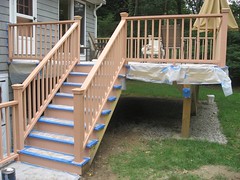
I had a deck built and I used pressure treated lumber for the railings (I should've stuck with all Pro Cell) and now I've got to make sure the wood is sealed well.  After talking to lots of people, I decided to paint them: enamel primer, then waterborne exterior semi-gloss (Benjamin Moore stuff is designed for this combo).  Primer is done.  Started with the final coat.  The color was "Tuscany" but it looks a lot like pink to me.  So I had to buy another color: "Acorn".  Rain, humidity, dirt+rain, and peeling blue tape are making this take forever.  I started painting about 3 weeks ago.

I'm planning to leave the deck frame with just Thompson's water seal, but if it looks bad against the painted railings and risers, then I'll have to do something else with it.

Time to continue painting.


UPDATE: I was only able to paint around most of the masking taped areas, and even then, it's going to need another coat.  It's been at least 14 days of having the blue tape and the plastic tarp on the deck and the rain, dirt, and time are destroying it, so I had to remove it today.

The next step should require a lot less masking along with some careful brush touch-up in some places.

It looks like the plastic tarp did something to discolor the Pro Cell decking in one area.  It think it was the water under the tarp.  Soap and water didn't work, alcohol didn't work, mineral spirits didn't work.  The decking is guaranteed and the guy who built the deck will replace anything that's permanently discolored.

Thursday, July 22, 2010

Back from Montana

The reunion was interesting.  It was fun.  It was a great experience.  There were so many interesting people.  I'm very glad I went.  I wrote the previous post to provide some background about where I'm coming from.  Coming back from Montana, it felt like I gained a lot of family.  Not something that happens just every day.

Wednesday, July 21, 2010

Heading to Montana

I was sitting in the middle seat on a totally full plane heading to a family reunion in Montana. Other than my sister Elaine and her husband Dominique (who I don't see very often), I hadn't seen or talked to any of these people in 25 years or more. It didn't seem like family. It felt like barging in on some other family's get together.

I'm not the sort of person who is any good at small talk. Social situations with large numbers of people are very energy draining. Even more so if they're strangers who all know each other.

Looking through the plane window, it always seems like the plane is barely moving, but before you know it, you find yourself far away.

It's a cliche to say time is like that. But it is like that.

It must have been forty years since I was a child at my grandfather's farm in Idaho. It sat in a narrow valley between two mountains, with a shallow creek running through. I remember it as mostly dry prairie grasses with a few trees here and there. There were two houses side-by-side made of what seemed like weathered wood within some sort of fenced in yard with a straight concrete walkway to a simple gate. A short dusty gravel private road led down to the slaughterhouse where the cows were butchered. I would sit on a wooden bench watching it all, maybe even eating a Wonder Bread peanut butter sandwich. It was like a live B-movie slasher film, with shows daily. Always the same show, different cow. My Grandpa Joe and Uncle Wendell and maybe others, I don't recall, perpetually in overalls, they'd be hacking and sawing away to the same script each time.

I remember my grandmother as being soft-spoken, down to earth, offering short bits of advice to do some-sort-of-thing or else some other bad thing would happen. My grandfather was happy, easy-going, he always seemed like he had everything already figured out. He'd walk down to the creek and toss the rocks around for a few minutes, then go back to the endless work that the farm seemed to demand.

I remember Uncle Wendell (I don't even know if that's the right spelling!) lived in the other house along with two kids... was it Joey and Tracy? I never saw the inside of the house: It was one of the great mysteries of the farm, along with whatever was in the musty smelling cellar, the supposedly terrifying insects hiding among the unexplainable implements in the shed, and the Indians living beyond the edge of the farm who I seem to recall would arrive to take away the parts of the butchered cow that no one wanted. I don't remember much about Wendell except that he seemed like an easy-going, hard worker like my grandfather, both of them seemed tall, thin, and sturdy. I vaguely remember Joey, who was around my age, and Tracy, an older kid.

Everything in the valley gently sloped upwards toward the mountain on one side. More of a hill than a mountain, really. It always seemed to me like you could simply walk up to the top without any trouble. I remember the adults and older kids did, but I never recall anyone saying what was up there. To me, it was another great mystery of the farm.

My branch of that family had moved to Los Angeles and it just seemed like the farm and the people there grew further away with every year.

I navigated through all the years since then with varying results. Lots of things I wish I'd done differently. Lots of things I'm glad I did differently: I've never fit anyone's idea of what a person ought to be or do. People ask where I'm from and I don't have any answer they're looking for. They're really not asking what location you lived in, they're trying to figure out what tribe you belong to.

Routinely I would recieve a handmade greeting card in the mail from Kathryn Smith who I recall was my aunt. I'd save the envelope and address with the idea that this year I would actually do the right thing and respond, but with nothing in particular to say, and having never responded to the last 20 cards, it seemed like an insurmountable obstacle.

I live in Boston now. It's fine, but I liked Rhode Island better. The people are a little less rude and arrogant there. Actually more than a little.

Over the years, every now and then, I've had dreams about my grandfather's farm from my childhood. Except the farmhouses are empty and it's like a 2-house ghost town. I'd start walking up the hill to finally see what's up there, but never make it. One time, I dreamed that I got to the top and it was a whole city, with no explanation how it got there.

So anyway, the airplane finally landed in Salt Lake City and I met up with Elaine and Dominique. We flew the next flight to Missoula where we got supplies at Costco and some other store and then headed up to Seely Lake.

Tuesday, July 20, 2010

Stories

I haven't blogged anything here for two years! I had planned to just leave this to Internet history, but I need another blog and this one fits for what I've got planned, it seems like a good place to continue from: far places. Long ago, I would tell people that if you want to write something that's interesting, it won't happen if it isn't a bit frightening to hit the send button: frightening because it's personal and genuine. My hope here is to actually write something interesting.

Thursday, March 20, 2008

Melbourne: Casino

NOTE:
[the financial blog is here]

On Wed, K and T and I went to the Crown Casino, a very large, upscale casino next to the river. I didn't bring my camera [actually it's M's camera] and missed getting pictures of the fire display along the river bank within the city. Massive flames leap from the tops of several pillars positioned along the walkway lined by outdoor restaurants. The flames are so hot that you feel the radiating heat immediately. It's quite alarming. The casino was quite big and snaked off into various directions to some unknown distance. In the food court was a Krispy Kreme.

Inside the casino, I lost all of my $20 on the roulette wheel. I think T lost the same amount. K did better. Some guy was obsessively placing huge bets on various roulette wheels in an odd sort of system involving lots of individual bets in patterns.

When you think of an upscale city casino like this one, you think of James Bond wearing a tuxedo keeping cool while making large bets next to mysterious bad guys with eye patches. In reality, it was three non-trendy engineers in standard business casual placing two dollar bets and anti-climactically running out of money. No background music. No mysterious bad guys... unless you count the obsessive guy shifting from table to table losing money. The moral of the story is that casinos make money.

At one point, I boldly chose not to place $100 on the number 1 on another roulette wheel. If the number 1 had come up, I would have essentially lost $3,500! Otherwise, I would have gained $100. I won! So overall, I gained $80 at the casino.

The funny part was that K had planned to show us both the flames and what must be an amazing indoor water show inside a huge open space in the casino area. The water show was turned off due to water restrictions from the current drought. So we went outside to see the flames which would happen at 8:00. Several minutes beforehand, we sat down at a strategic point near one of the pillars. I noticed that no one else seemed to expect this show. People walked by just as always. No one was stopping for the show. At 8:00, nothing happened. Time slowly ticked forward with no fire. K was getting a bit concerned about two non-events in a row when there was a faint hissing sound at the top of the pillar. Slowly the fire rose and then there was a choreographed show among the various pillars, with loud bursts of flame. Apparently, R calls these things "pigeon burners" or something like that.

Melbourne: Forest

North Americans should realize that directly beneath their feet is an alternate universe. A sort of Austin San Diego Francisco Seattle. Night is day and day is night. On a normal working day at the office, you can have lunch in the primordial hills where you'll have to literally defend your food from 6 kookaburras.


On Thurs, I again forgot my camera when R and I went out to lunch in the hills. The forest here is truly amazing. The trees are enormously tall. The ferns make everything look prehistoric. And the forest is filled with bright colored birds that you'd find in a pet shop. They actually appear much brighter than the photo below.


I got back to the hotel Thursday after work and fell immediately asleep for 2 hours. I've been very tired these last two days.

Tuesday, March 18, 2008

Melbourne: more photos

Getting ready to leave the workplace I'm visiting, I lifted up my laptop case and placed it on the desk. It fell over onto the telephone which somehow pressed the button to make an announcement to the entire company! To make matters worse, the way it fell caused the phone to produce a lot of feedback over the loudspeaker. I tried to signal to K to help turn the thing off. This went on for a while until K turned it off. This was then followed by an announcement by the top managing director thanking Jimi Hendrix for the performance. It was a very funny way to end the workday.

More photos from Sunday...

Another black swan sighting.


A lizard with a false head so attacking birds will harmlessly attack its rear end.


The national bird, the kookaburra, which makes loud funny noises.


A typical rural road.


Snacks


The Tazmanian Devil is behind an electric fence.


A wombat.


The yield signs here say "Give Way".

Monday, March 17, 2008

Melbourne: Hotel Power Failure

I arrived home on Monday thinking that "tonight, I'm doing a whole lot of nothing." The hotel was dark. They informed me on the way in that it was a power failure. Should be fixed soon. Take the stairs.

I played a lot of freecell in the dark on laptop battery power. Three hours later, the power came back on.

I had bought a 6-pack of Sprite earlier in the day. Looks like a shortened US 12-pack. It contains sugar instead of the usual corn syrup etc. in the US, so it tastes oddly like candy. It's not subtle.

More pictures from the zoo...

We got to the zoo very early so it didn't reach this temperature until on the way to the wineries.


Here's a kangaroo mother with a baby joey in her pouch.


Here I am petting a wallaby.


Here's a baby-eating dingo.


The koala was asleep, as they usually are.


And some birds...


Sunday, March 16, 2008

Melbourne: bats

Here's a video of large bats at the Healesville Sanctuary. In addition to the Sanctuary, we went to a winery and R's home. More to follow in a future post.


I have another bats video, but it keeps failing when I upload it to YouTube.

Saturday, March 15, 2008

Melbourne: trip to the city

So K and I went into the city today. We toured the open air market with a history similar to Haymarket Square in Boston. K remembers his family buying green groceries and stuff at the market when it was more for the essentials than a tourist spot. Unfortunately, I didn't think to get any pictures of the market overall. I suppose it can be sad to see a quaint "real" market transform into a tourist site, but to me, it's a sign of increasing wealth of the population. K noticed that the roof of the market, while old and authentic, had solar panels attached to the top of it. I said that this was the final proof that the old market was gone now.

The market had shoes, t-shirts, boomerangs, American rock star t-shirts, opals, wooden toys, etc. Most importantly, it had this mannequin.


Going through the local department store, it was clear that the prices were much higher than the US. Polo shirts that might cost $40 were something like $100. Calvin Klein jeans were...


Remember that the Australian dollar is pretty much one-for-one against the US dollar. And these jeans must be tailored for whatever length you need.

Apparently there's a long story behind the legal battles between Burger King and Hungry Jacks. If I recall correctly, Hungry Jacks won.


We crossed over the Yarra River to the western side of Melbourne where there's an area that has a waterfront commercial district (Westgate Park) with boat docks and serious sailboats. I didn't get many pictures and the ones I got didn't do justice to the place.

There's a lot of really old architecture of all sorts in Melbourne from old colonial to all sort of modern stuff. Again, I didn't get pictures.

The Westgate Bridge is famous in Melbourne. Apparently, the first one fell down in 1970, killing 35 people.


This is driving back towards the main city.


And like most large cities, there's a Chinatown.


Here's a typical Melbourne street.


As far as pictures go, I really missed a lot of good opportunities today.

Melbourne: P91

K showed me all around Melbourne today and I must say that I am very impressed with the city. Lots of really great areas. It's very impressive. I'll post pictures soon. However, at one point, we crossed over the major river that separates the city, parked the car, and walked up to the edge of the river to see the view of the Melbourne skyline.

K was very puzzled when I stopped and pointed out that there was a black swan in front of us. He grew up in Melbourne and said they're very common. It was very funny that standing there with the impressive skyline of Melbourne, with sailboats going by, with all the scenery, that I would be taking pictures of what I'd have to admit is a fairly ugly bird. Even the author of The Black Swan said it's an ugly bird. This one was tagged for some reason or another, which simply adds to the humor of it. P91.

While I would have been happy if I had intentionally sought out and found a black swan here, just stumbling into one unexpectedly, without warning, in the middle of day trip in Melbourne was perfect.


I can't believe that I forgot that black swans are in Australia. When I read the book, I recall thinking that I'd never see one myself because they're all the way on the other side of the world.

Friday, March 14, 2008

Melbourne: some pictures

Vegemite is a very Australian condiment. In the US we call it vegetable broth concentrate [not really]. It's widely recognized as the 2nd saltiest substance after pure sodium chloride.


It looks like melted chocolate and has the consistency of cream cheese.


I was in my hotel, doing some experiments when suddenly I needed 400cc of sulfuric acid and a couple of beakers. So where do you go in that situation?


This is what we call a drug store in the US. Although the chemist carries only medical and related things. No singing big mouth bass fish, no cleaning supplies, etc.

After completing the experiment, I decided to go out for a hamburger and onion rings, but I noticed the hotel vending machine already had this covered...


If you ever wanted to know what Australian license plates look like, here's a sample...


Here's the cat that narrowly escaped getting a "cat" scan (see earlier posts).


Here an Australian electrical outlet. I'm constantly forgetting to flip the switch after plugging something in and wondering why it's not working.


Here's a rotary sign. Notice that the traffic goes the opposite way. People drive on the left and the steering wheel is on the right side. This is dangerous for US pedestrians who look the wrong way before crossing. This is especially bad when you have crosswalks across complicated roads.


The crosswalks make clicking sounds when it's ok to cross (for deaf people). Where I live, the crosswalks make a chirping noise. Presumably malicious birds don't attempt to fool deaf people.


Here's what the hotel charges to do laundry:
one shirt: $10.00
one t-shirt: $5.85
one pair of socks: $4.10
etc.

For a cheap Wal*Mart shirt, it's almost cheaper to throw the shirt away and buy a new one.

So I decided to do my own laundry. The laundry detergent packaging was a bit retro.


You're supposed to rip open the bag and then dump half of it into the washer. This requires a lot of skill in being able to correctly measure half.


I'll have more pictures later. Today (Saturday) K and I are hitting the town. On Sunday, I'm headed to the zoo and a winery with R and family.